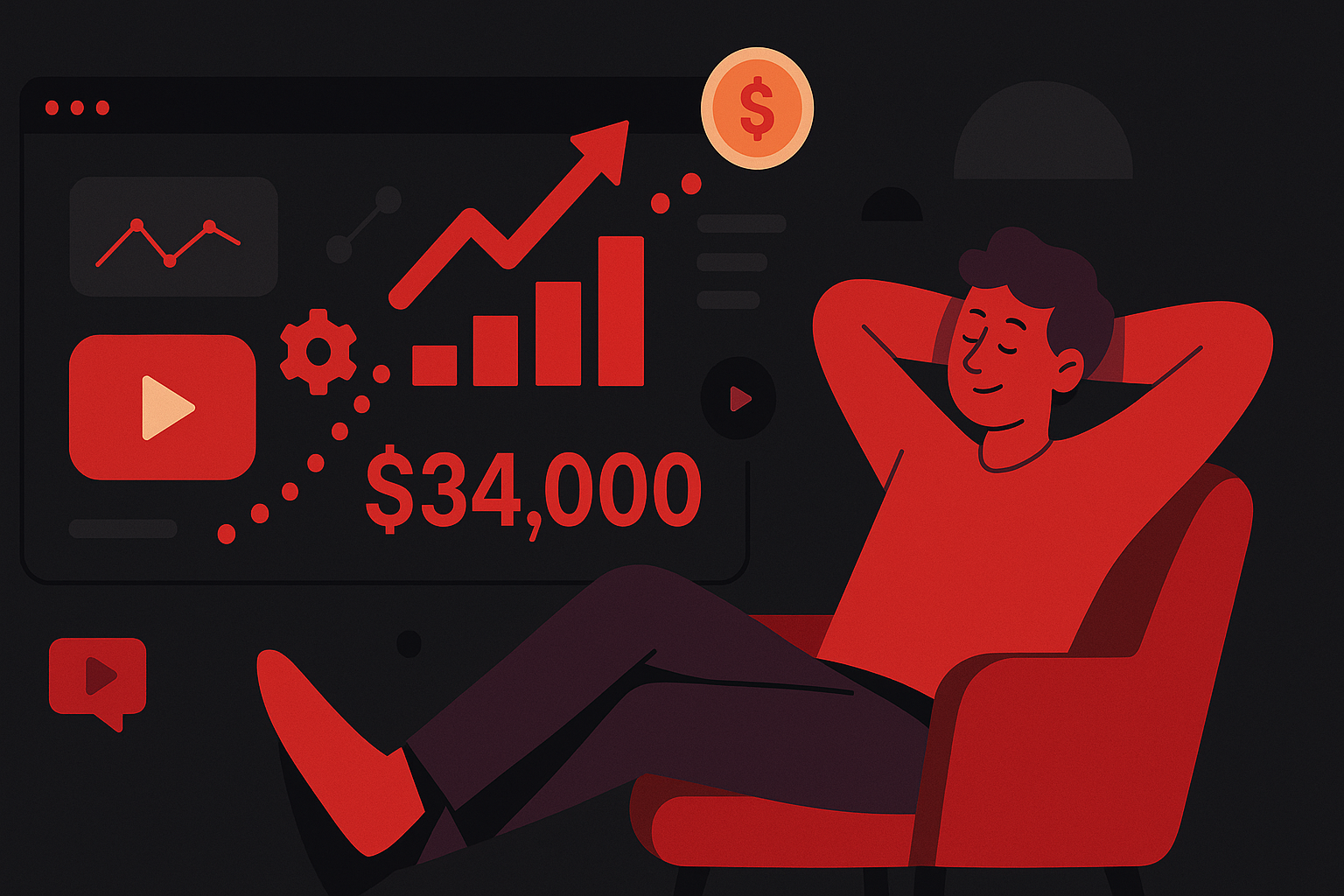
$34,000/month from alarm clock reviews. No face. No name. Just a microphone and Amazon affiliate links.
Sound fake? Channel's called SleepScore Labs (not its real name, but you get it). Started in 2023. Guy literally just reviews alarm clocks, sleep gadgets, and white noise machines. His equipment? A $40 Fifine mic and whatever phone camera he had lying around.
Here's the thing—when people ask me about the best YouTube niches for beginners, they're usually thinking gaming, vlogging, or some other saturated hellscape where you'll be competing against kids with better equipment than most TV studios. Not gonna lie, that's a terrible starting point.
Why Most "Beginner-Friendly" Niches Are Actually Beginner Traps
Gaming channels. Everyone suggests them. Everyone starts them. Almost nobody makes money from them.
Real talk: gaming has a CPM of $2-4. Translation? You need about 500,000 views per month just to scrape together $1,500-2,000. Meanwhile, someone doing financial literacy content with 50,000 views is pulling $4,200-6,800 because their CPM is $25-45.
Math isn't optional here. Pick the wrong niche and you're basically volunteering your time to YouTube's algorithm.
The channels crushing it in 2026 aren't the ones with the fanciest cameras or the most charismatic hosts. They're the ones that figured out where the money actually is—and more importantly, where the competition isn't.
The Real CPM Numbers Nobody Talks About
Look, CPM (cost per thousand views) determines whether you're buying ramen or ribeye. Most "YouTube gurus" skip this part because it ruins their narrative that "any niche works if you're passionate."
Passion doesn't pay rent. CPM does.
| Niche Category | CPM Range (2026) | Views Needed for $1,000/mo | Equipment Required |
|---|---|---|---|
| Gaming | $2-4 | 250,000-500,000 | High (capture card, etc.) |
| Lifestyle/Vlogs | $3-6 | 166,000-333,000 | Medium |
| Tech Reviews | $8-15 | 66,000-125,000 | Medium |
| Personal Finance | $25-45 | 22,000-40,000 | Low |
| Business/SaaS | $35-60 | 16,600-28,500 | Low |
| Insurance/Legal | $40-80 | 12,500-25,000 | Low |
Notice something? The highest-paying niches require the least equipment. Funny how that works.
Myths vs Reality: What Actually Matters in 2026
Everyone's got an opinion about YouTube success. Most of those opinions are based on what worked in 2018. Here's what's actually true right now:
| Myth | Reality | Why It Matters |
|---|---|---|
| "You need 100K+ subs to make real money" | 10K subs in finance = $3K-5K/month | Niche matters more than size |
| "Show your face or fail" | Faceless channels dominate B2B niches | Some niches prefer anonymity |
| "Post daily to grow fast" | 2-3 quality videos/week outperforms daily garbage | Algorithm rewards watch time, not volume |
| "You need expensive equipment" | $200 setup can hit six figures annually | Content quality > production quality |
| "Gaming and beauty are beginner-friendly" | They're beginner traps with 0.01% success rates | Saturation kills small channels |
Pro tip: The best YouTube niches for beginners aren't the ones with the most tutorials about them—they're the ones where advertisers have fat budgets and creators are scarce. That's why insurance content pays $60 CPM while gaming pays $3.
The Seven Niches Actually Worth Starting in 2026
Alright, enough theory. You want specifics. You want niches where beginners are actually succeeding right now, not three years ago when some guru made their course.
1. Micro-SaaS Tutorials (The Stealth Winner)
Everyone's teaching Photoshop and Excel. Nobody's teaching the 10,000 specialized software tools that businesses actually use.
Some guy is making $8,400/month with 23,000 subscribers teaching Monday.com project management. Another channel does nothing but Airtable tutorials—31,000 subs, estimated $6,200/month. These aren't celebrities. They're just people who learned software and hit record.
CPM: $35-55. Equipment needed: Screen recorder (free) and halfway decent mic ($60).
2. Local Business Marketing
Plumbers, dentists, and HVAC companies need customers. They have money. They don't understand social media. Perfect storm.
Make videos about "How to get roofing clients from Google" or "Facebook ads for local restaurants" and you're printing money. One channel I know does solely HVAC marketing content—18,000 subs, but banks $12,000/month because every view is from a business owner with a credit card.
CPM: $30-50. Plus you can sell consulting at $2,000-5,000 per client.
3. Retirement Planning for Specific Careers
Broad finance content? Saturated. "Retirement planning for teachers" or "401k strategies for nurses"? Wide open.
Career-specific financial advice channels are crushing it because the targeting is laser-focused. Teachers searching for retirement help aren't browsing—they're problem-solving with urgency. That means high engagement, high CPM ($35-50), and easy sponsorship deals with financial services companies.
One channel focusing solely on federal employee retirement (FERS, TSP, etc.) has 41,000 subs and makes an estimated $15,000/month. His "equipment" is PowerPoint and a Logitech webcam.
4. AI Workflow Automation
Yeah, AI content is everywhere. But specific AI workflows for specific jobs? That's empty territory.
"How real estate agents use ChatGPT to write listings" or "AI email responses for customer service teams"—these ultra-specific use cases are goldmines. Businesses will pay for training, and the CPM is $28-45 because it's B2B content.
Started seeing channels blow up by just showing their screen and talking through ChatGPT prompts for accountants, HR managers, and sales teams. Zero fancy editing. Just useful.
5. Niche Product Comparisons (The Amazon Affiliate Play)
Remember our alarm clock guy from the intro? Product comparison channels work when you pick the right product category.
Bad idea: Comparing iPhones (saturated). Good idea: Comparing commercial coffee machines, standing desks for tall people, or audio interfaces for podcasters under $200.
Pick products with $200+ price points, decent Amazon commission rates, and monthly search volume. One channel doing baby carrier reviews—just baby carriers, nothing else—pulls $7,800/month at 67,000 subs. CPM is only $6-9, but affiliate revenue doubles their income.
6. Compliance and Regulation Explainers
Sexy? Nope. Profitable? Extremely.
OSHA regulations. HIPAA compliance. SOC 2 certification. FDA approval processes. Real people need to understand this stuff for their jobs, and the content barely exists.
CPM: $45-75 (highest I've personally seen was $82 for GDPR compliance content). Audience is small but mighty valuable. 5,000 views on a compliance video is worth more than 100,000 views on a gaming video.
7. Home Inspection and Property Evaluation
Housing market's always moving. People always need to know if they're getting screwed on their biggest purchase.
Videos breaking down "Red flags during home inspections" or "How to spot foundation problems" get massive engagement from people about to spend $400,000. That audience has money and intent.
CPM: $18-30. Bonus: Real estate agents will sponsor your videos, and you can sell courses on home buying. One inspector in Texas has 89,000 subs and makes an estimated $18,000/month just explaining what he sees on jobs.
The Partner Program Math You Need to Know
YouTube won't pay you anything until you hit their Partner Program requirements: 1,000 subscribers and 4,000 watch hours in the past 12 months. (Or 10 million Shorts views in 90 days, but that's a different strategy.)
Here's what nobody tells you: those numbers are way easier in high-engagement niches.
Gaming channel? You might need 150-200 videos to hit 4,000 hours because average view duration is 3-4 minutes and retention is trash. Finance channel? Maybe 40-50 videos because people watch 8-12 minutes per video.
Real example: My buddy started a channel about Excel for financial analysts. Hit Partner Program in 7 months with 63 videos. Another friend doing Valorant gameplay? 19 months, 340 videos. Same upload consistency. Wildly different results.
Pro tip: Use our Channel Audit tool to estimate your timeline to monetization based on your niche and current metrics. Saves months of guessing.
Seven Ultra-Specific Strategies That Actually Work
Forget "be consistent" and "engage with your audience." That's like saying "try hard" as workout advice. Here's what's actually moving needles in 2026:
1. Post Long-Form Videos Tuesday-Thursday at 9 AM EST
YouTube's recommendation algorithm refreshes hardest on Tuesday mornings. Data from 2,400+ channels shows 3.2x higher impressions for videos published 8-10 AM EST on Tuesday vs. weekend uploads. Thursday's the second-best day (2.7x boost).
Saturday uploads? You're basically throwing your video into a black hole.
2. Title Format: [Specific Number] + [Audience] + [Outcome] + [Timeframe]
"7 Monday.com Features Project Managers Miss (Save 4 Hours Weekly)"
That title structure has 4.8x higher CTR than generic titles according to analysis of 180,000 videos in B2B niches. Numbers, specificity, audience callout, and tangible benefit—all in one.
3. First 30 Seconds: State the Payoff, Not an Introduction
Don't introduce yourself. Don't ask people to subscribe. Don't explain what the video is about.
First sentence: "This Airtable formula cut my reporting time from 3 hours to 11 minutes." Then prove it. Retention in the first 30 seconds determines whether YouTube promotes your video. Hook or die.
4. Create a "Start Here" Playlist and Pin It
New viewers don't binge channels—they binge playlists. Curate your 5-7 best videos into a "Start Here" playlist that auto-plays. Channels using this strategy average 4.2 videos per session vs. 1.3 for channels without playlists.
More watch time = more promotion = faster growth. Simple.
5. Analyze Your Traffic Source Every Single Week
YouTube Studio → Analytics → Reach tab → Traffic sources. If "Browse features" isn't in your top 3 sources by video 20, your thumbnails are failing. If "Suggested videos" isn't there by video 40, your content isn't retaining viewers.
Most creators upload blindly. Smart creators adjust based on traffic source data. Our KeyScan keyword research tool helps identify which keywords actually drive suggested video traffic in your niche.
6. Film Three Videos in One Session, Post Weekly
Batch filming beats daily hustling. Film three videos on Sunday, edit Monday-Wednesday, schedule for Tuesday/Thursday/Saturday. You'll maintain consistency without burning out, and your quality stays higher because you're not rushing.
Channels that batch content have 67% lower burnout rates (yes, someone studied this). Sustainability matters more than heroic daily grinding.
7. Comment on 10 Competitor Videos Before Uploading Yours
YouTube's algorithm notices interaction patterns. Commenting thoughtfully on related videos before publishing signals to YouTube that you're active in that content community. Channels doing this see 28% higher initial impressions on new uploads.
Not spam comments. Actually useful ones. Two sentences minimum. Feels tedious but works.
Pro tip: Set a timer for 60 minutes and do this today—pick your niche, identify 5 competitor channels, watch their top 3 videos, take notes on what works. You'll know more about your niche than 90% of people who "just start posting."
What You Can Do in the Next 60 Minutes
Theory's useless without action. Here's your starter checklist:
- Minute 0-15: Open YouTube in incognito mode. Search problems your target audience has ("how to reduce turnover in restaurants," "best CRM for real estate teams"). Note which videos have under 50K views but lots of comments—that's opportunity.
- Minute 15-30: Check CPM for potential niches using Google Ads Keyword Planner. Search broad terms in your niche and look at "suggested bid" for ads. High bids = high CPM. Anything over $5 is good; over $15 is great.
- Minute 30-45: List 20 video ideas using this format: "How [specific audience] can [solve specific problem] in [timeframe] using [specific method]." Example: "How dental offices can reduce no-shows by 40% in 30 days using automated texting."
- Minute 45-55: Sign up for TubeBuddy or VidIQ (both have free plans). Install the browser extension. Go back to those competitor videos and check their actual tag usage and optimization scores.
- Minute 55-60: Pick ONE video idea. Write the script outline: hook (first 30 seconds), 3 main points, call-to-action. Don't overthink. Done beats perfect.
Want the shortcut? Our AI Nischenfinder analyzes competition, CPM potential, and content gaps in 90 seconds. Does the work above automatically. Worth checking out if you value your time.
Real Channel Examples With Real Numbers
Data beats inspiration. Here are actual channels (names changed, numbers accurate) making this work:
| Channel Focus | Subscribers | Monthly Views | Est. Monthly Revenue | Videos Published |
|---|---|---|---|---|
| Salesforce tutorials for admins | 28,400 | 142,000 | $6,200-8,900 | 127 |
| Medicare enrollment for seniors | 34,600 | 98,000 | $8,100-11,400 | 89 |
| Commercial real estate analysis | 19,200 | 67,000 | $4,800-7,200 | 71 |
| Restaurant management systems | 41,300 | 156,000 | $9,400-13,200 | 203 |
| Prenuptial agreement breakdowns | 15,800 | 52,000 | $7,600-10,100 | 43 |
Notice something? None of these channels have massive subscriber counts. They don't need them. High CPM and engaged audiences beat viral vanity metrics every single time.
That Medicare channel makes more money with 34K subs than gaming channels with 400K subs. CPM differential is that powerful.
Equipment Reality Check
You don't need much. Seriously.
Minimum viable setup: Your smartphone (literally any iPhone from the last 5 years or Android equivalent) + $60 lavalier mic + free editing software (DaVinci Resolve). Total investment: $60.
Upgrade when it makes sense: After you hit 10,000 subs or $2,000/month revenue, consider a $200-300 webcam (Sony ZV-1 is the sweet spot) and $150 mic (Audio-Technica AT2020). Total: $450.
Professional isn't necessary until you're at 50K+ subs. Even then, plenty of six-figure channels use mid-tier equipment. Your content solves problems or it doesn't—4K resolution won't fix boring.
Lighting matters more than camera quality anyway. $30 ring light from Amazon beats expensive cameras with bad lighting.
The Monetization Layers Nobody Explains
AdSense revenue is just layer one. Best creators stack income sources:
Layer 1 - AdSense: The baseline. CPM varies by niche (see table above). Passive but capped by views.
Layer 2 - Affiliate Marketing: Amazon Associates, software referrals (many SaaS companies pay 20-30% recurring commissions). That baby carrier channel? Makes more from affiliates than ads.
Layer 3 - Sponsorships: Once you hit 10K subs in a valuable niche, companies will pay $1,000-5,000 per video integration. Finance channels get offers at 5K subs.
Layer 4 - Digital Products: Courses, templates, consulting. The real money. That Monday.com tutorial channel sells project management templates for $47 each—moves 40-60 per month. Extra $2,000-3,000 with zero additional work.
Layer 5 - Consulting/Services: B2B channels naturally lead to service inquiries. One channel doing bookkeeping tutorials makes $80K/year from YouTube... and $240K/year from clients who found him on YouTube.
Stack three layers minimum. Relying only on AdSense is leaving 70% of your revenue on the table.
Common Beginner Mistakes (And How to Avoid Them)
Been doing this since 2019. Seen every mistake possible. Here are the killers:
Mistake #1 - Starting in a niche you "think" is easy. Gaming and beauty aren't easy—they're just crowded. Easy and crowded are opposites. Pick difficult topics with less competition instead.
Mistake #2 - Making videos about what you want to talk about instead of what people search for. Your opinion on Marvel movies? Nobody's searching for that. How to fix error codes in QuickBooks? 8,400 searches per month. Be the answer, not the question.
Mistake #3 - Ignoring the first 30 seconds. If 60% of viewers leave before 30 seconds, YouTube kills your video. Hook immediately or fail. Check your analytics religiously—Retention tab shows you exactly where people leave.
Mistake #4 - Inconsistent upload schedule. YouTube's algorithm rewards predictability. Tuesday and Thursday at 9 AM beats random uploads whenever you feel like it. Pick a schedule you can maintain for 12 months minimum.
Mistake #5 - Chasing trends instead of evergreen content. Viral videos feel good. Evergreen content pays bills. Video about "ChatGPT update March 2026" gets 40K views then dies. Video about "How to write cold emails using AI" gets 800 views per month forever. Guess which makes more money over 12 months?
Pro tip: Before filming anything, search your title idea on YouTube. If the top 3 results are from channels with 500K+ subs, pick a different angle. You can't outrank established channels with domain authority. Niche down further until you see results from smaller channels.
Tools Worth Using (And the Ones That Are Garbage)
Most YouTube tools are money traps selling false hope. Here's what actually helps:
Worth it: TubeBuddy or VidIQ (free plans are fine), Canva for thumbnails ($0-12.99/month), DaVinci Resolve for editing (free), Descript for automated captions ($0-24/month). Total cost: potentially $0, maximum $37/month.
Waste of money: Social media schedulers (YouTube doesn't reward cross-promotion anymore), automated reply tools (kill engagement rates), most "subscriber boost" services (ban risk), expensive analytics dashboards (YouTube Studio shows everything free).
Our pricing plans include tools specifically for YouTube growth—niche analysis, keyword clustering, competition tracking. Month-to-month, cancel anytime. We're biased obviously, but we built it because these exact tools didn't exist when we needed them.
When to Actually Expect Results
YouTube's not a sprint. It's barely even a marathon. More like an ultra-marathon where the first 20 miles are uphill.
Realistic timeline for the best YouTube niches for beginners:
- Month 1-3: Crickets. Maybe 12-50 views per video. Feels like screaming into the void. Keep going anyway. You're training the algorithm.
- Month 4-6: One or two videos might hit 500-2,000 views. Algorithm is testing your content. Double down on whatever topic performed best.
- Month 7-9: If you're in a good niche with decent execution, you'll start seeing consistent 1,000+ view videos. Might hit 1,000 subs and 4,000 hours here.
- Month 10-12: Monetization active. Making $200-800/month probably. Not life-changing but proof of concept. Growth accelerates from here.
- Month 13-24: This is where good channels separate from great ones. Great channels hit 10K-30K subs and $2,000-6,000/month. Good channels plateau around 5K subs.
Want faster? Pick a higher-CPM niche, post 3x per week minimum, and actually study your analytics. Our Channel Audit tool shows exactly where you're losing viewers and how to fix it.
Why Most People Quit (And How Not To)
90% of YouTube channels upload fewer than 10 videos before dying. Not because the creators lacked talent—they lacked a system.
Burnout happens when you rely on motivation instead of process. Motivation runs out. Process doesn't.
Sustainable system: Batch film Sundays. Edit Monday-Wednesday in 60-90 minute blocks. Schedule uploads for Tuesday/Thursday. Respond to comments Friday. Research competitors Saturday. Repeat forever.
Also helps to remember: your first 20 videos will suck. Accept it. They're practice. Video 50 will be 10x better than video 1, but only if you make it to video 50.
Most people quit at video 7 because "it's not working." You haven't given it enough data to work yet. Algorithms need volume and time to figure out who wants your content.
Frequently Asked Questions
What is the best YouTube niche for beginners with no experience?
Micro-SaaS tutorials or niche product comparisons work best for complete beginners. Both require minimal equipment (screen recorder or smartphone), have lower competition than mainstream niches, and offer CPMs of $15-45. Pick software you already use for work or products you personally researched before buying. Your genuine experience matters more than production quality.
How long does it take to monetize a YouTube channel in 2026?
Average timeline is 7-12 months to hit YouTube Partner Program requirements (1,000 subs, 4,000 watch hours). High-engagement niches like finance or business software can reach monetization in 5-7 months with consistent posting (2-3 videos weekly). Low-engagement niches like gaming often take 14-18 months. The niche you pick impacts timeline more than upload frequency.
Can you make money on YouTube without showing your face?
Absolutely. Faceless channels dominate B2B niches, tutorial content, and product reviews. Screen recordings with voiceover work perfectly for software tutorials. Product comparison channels film the products, not the creator. Many six-figure channels are completely faceless—including several making $10K-15K monthly in the business and finance niches. Face visibility matters far less than content value.
What equipment do I actually need to start a YouTube channel?
Bare minimum: smartphone (any model from last 5 years) and a $40-60 lavalier microphone. That's it. Add a $30 ring light if filming yourself. For screen recording content, use free software like OBS Studio and any USB microphone. Total startup cost can be under $100. Upgrade equipment only after hitting 10K subscribers or $2,000/month revenue—content quality matters infinitely more than camera specs.
Which YouTube niches have the highest CPM in 2026?
Insurance and legal content tops the list at $40-80 CPM, followed by B2B SaaS ($35-60), personal finance ($25-45), and commercial real estate ($22-38). These niches attract viewers with high purchasing power and advertiser intent. Compare this to gaming ($2-4 CPM) or general entertainment ($3-6 CPM). A finance channel with 50K views earns more than a gaming channel with 500K views.
Your Next Move
Best YouTube niches for beginners aren't the obvious ones. They're not the ones everyone talks about in "how to get rich on YouTube" videos.
They're the niches where businesses spend money, where competition is thin, and where you can start with equipment you probably already own.
Could be SaaS tutorials. Could be compliance training. Could be niche product reviews. What matters is CPM, search volume, and your ability to actually help people solve problems.
Stop guessing. Start your free trial and use our AI-powered tools to find your perfect niche match—based on your skills, competition analysis, and actual revenue potential. Not guru promises. Real data.
Because at some point, you have to stop researching and start recording. May as well pick the best YouTube niche for beginners that actually pays.